
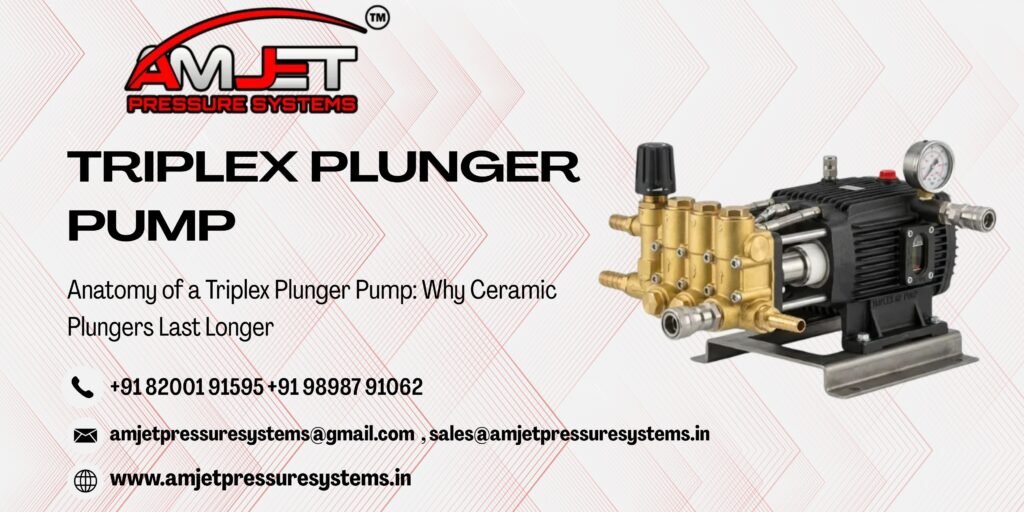
Anatomy of a Triplex Plunger Pump: Why Ceramic Plungers Last Longer
In demanding industrial environments, fluid transfer and high-pressure cleaning operations cannot afford unexpected equipment downtime. Whether you operate a large-scale manufacturing plant, an industrial cleaning service, or a specialized equipment facility, the reliability of your entire fluid system depends on a single core component: the pump. At the heart of most heavy-duty cleaning systems lies the reciprocating positive displacement pump. Among these, the Triplex Plunger Pump stands out as the undisputed industry standard for delivering smooth, continuous, and pulsation-free fluid flow under extreme pressures.
However, the true operational durability of these machines comes down to component-level engineering—specifically, the material composition of the plungers. Traditional pumps often relied on metallic components that degraded rapidly under constant friction. Modern engineering, however, utilizes advanced ceramic materials that completely transform how these systems perform. Understanding how a triplex pump is built and why its material choices matter helps plant managers, maintenance engineers, and procurement teams select equipment that drastically minimizes repair frequency and operational costs.
Core Mechanics: How a Triplex Plunger Pump Operates
To understand why triplex pumps dominate heavy-duty industries, it is essential to look at how they generate high pressure. Unlike centrifugal pumps, which use rotational kinetic energy to move fluids, a triplex positive displacement pump utilizes three synchronized plungers moving back and forth within precision-machined cylindrical chambers.
The pumping cycle occurs in two continuous phases:
The Suction Stroke: As the plunger retracts backward from the chamber, it creates a localized low-pressure zone. This negative pressure forces the inlet check valve to open, drawing fluid smoothly into the fluid cylinder.
The Discharge Stroke: As the plunger moves forward into the chamber, it displaces the volume, forcing the inlet check valve shut and pushing open the discharge check valve. The fluid is then forced out of the discharge port at high velocity and pressure.
Because a triplex configuration features three evenly phased plungers (staggered at 120-degree intervals), their discharge strokes overlap seamlessly. This synchronized overlapping design eliminates the heavy pressure spikes, fluid pulsing, and water hammer effects common in duplex or single-plunger designs. As a result, downstream hoses, unloader valves, and connected industrial accessories experience significantly less structural stress and mechanical fatigue.
Why Ceramic Plungers Outperform Traditional Steel Plungers
In older or lower-cost pump configurations, stainless steel or chrome-plated metal plungers were the industry standard. While metal has high structural strength, it possesses a critical weakness when subjected to high-pressure reciprocating motion: friction.
Continuous movement against high-pressure water packings causes metal plungers to pit, score, and wear down rapidly. Once a metal surface develops microscopic grooves, it acts like sandpaper against the rubber or synthetic seals, leading to rapid water leakage and loss of pressure. This is why modern high-performance systems utilize advanced ceramic plungers.
Extreme Surface Hardness and Smoothness: Engineering ceramics possess a vastly superior hardness rating compared to steel or chrome-plated alternatives. They can be polished to an mirror-like finish that generates minimal friction against the high-pressure packing seals.
Total Resistance to Thermal Shock and Chemical Corrosion: Industrial water systems often handle fluctuating fluid temperatures, harsh chemical additives, or abrasive particulates. Ceramic material is chemically inert, meaning it will never rust, pit, or degrade when exposed to aggressive media or corrosive operating environments.
Dramatically Extended Seal Life: Because ceramic surfaces remain flawlessly smooth over thousands of operational hours, they do not chew up or degrade the high-pressure packing seals. Fewer seal replacements mean lower spare parts consumption, reduced maintenance labor costs, and maximized operational uptime.
Key Maintenance Practices to Maximize Pump Lifespan
While investing in a robust triplex pump equipped with high-grade ceramic plungers guarantees exceptional baseline longevity, implementing proper preventive maintenance routines ensures your equipment operates at peak efficiency for years:
Maintain Proper Inlet Filtration: Always ensure incoming water supply lines are protected with high-efficiency filters. Fine silt, sand, or mineral debris slipping past the filtration system can become trapped between the plunger and seals, causing premature abrasive wear.
Monitor Crankcase Lubrication: Change the pump crankcase oil at recommended operational intervals. Clean, high-grade oil protects the internal crankshaft, connecting rods, and bearings from friction wear and thermal breakdown.
Inspect Check Valves and Seals Regularly: Periodically check for minor pressure fluctuations or moisture around the fluid end, which can indicate early wear on check valves or packing seals before they result in a complete operational failure.
Conclusion
Selecting the right fluid-end components determines whether your facility experiences continuous production or costly maintenance bottlenecks. Equipment built with precision mechanics and advanced materials provides the reliability required for heavy industrial applications.
Explore our advanced range of heavy-duty Triplex Plunger Pumps designed with world-class engineering to handle your toughest operational demands, delivering unmatched reliability and performance.