Hydro Jetting Safety Equipment Guidelines: Hose Whip Checks, Burst Sleeves, and Foot Valves
High-pressure water jetting and hydro blasting are indispensable tools across power plants, chemical refineries, shipyards, and municipal networks. However, operating equipment at pressures between 350 Bar and 2500+ Bar (5,000 PSI to 36,000+ PSI) introduces extreme mechanical and fluid hazards.
A pinhole leak in a high-pressure hose can instantly inject water under the skin, causing severe tissue damage and internal toxicity. Similarly, a severed coupling or unsecured hose end can whip uncontrollably with enough force to cause fatal blunt-force trauma.
To prevent job-site incidents and comply with international industrial safety regulations (such as WJTA and OSHA standards), plant safety officers must enforce strict safety hardware protocols before any high-pressure pump is engaged.
The Primary Mechanical Hazards of High-Pressure Water Jetting
Understanding why safety devices are non-negotiable requires looking at the failure modes of pressurized fluid systems:
+-----------------------------------------------------------------------+
|                    HIGH-PRESSURE FLUID FAILURE MODES                  |
|                                                                       |
|  COUPLING SEPARATION: Hose disconnects under pressure and whips       |
|                       uncontrollably due to reaction force.           |
|                                                                       |
|  PINHOLE / HOSE BURST: High-velocity micro-jet cuts skin and causes   |
|                        deep tissue fluid injection injuries.          |
|                                                                       |
|  OPERATOR DISORIENT:   Nozzle backs out of tube runs accidentally     |
|                        and turns back toward the technician.          |
+-----------------------------------------------------------------------+
1. Hose Whip Checks: Preventing Violent Coupling Separations
A whip check (or hose restraint cable) is a heavy-duty, braided steel wire cable installed across hose-to-hose and hose-to-pump connections.
+-----------------------------------------------------------------------+
|                      HOSE WHIP CHECK RESTRICTION                      |
|                                                                       |
|      [Pump Outlet / Rigid Pipe] <====== Cable ======> [Pressure Hose] |
|                                 (Bridging Joint)                      |
|                                                                       |
|  If the quick-disconnect fitting fails, the steel cable catches the   |
|  hose instantly, preventing it from whipping wild under pressure.    |
+-----------------------------------------------------------------------+
Installation Standards
Never install with slack: The cable loop must fit snugly over the hose body on both sides of the fitting joint.
Rating Check: Ensure the whip check is rated for the outer diameter (OD) and bursting pressure rating of the hose assembly.
Placement: Mandated at the pump manifold discharge, between all extension hoses, and directly before the operator’s foot control valve manifold.
2. Anti-Burst Hose Protection Sleeves
High-pressure flexible lances and supply hoses undergo continuous abrasion as they slide over concrete floors, metal tube sheets, and sharp flange edges. Over time, internal wire braiding weakens, leading to hose bursts.
How Burst Sleeves Work
A burst protection sleeve is a heavy-duty nylon or Kevlar woven sheath installed over the high-pressure hose, particularly on the section closest to the operator (the first 3 to 6 meters from the spray gun or lance).
Fluid Diffusion: If a pinhole leak or outer cover burst occurs, the tightly woven sleeve traps the high-velocity water jet, converting a dangerous concentrated stream into a safe, atomized mist.
Abrasion Resistance: Protects the primary pressure wire braid from physical wear caused by dragging across rough factory floors.
3. Foot Control Valves & Dump Valves: Instant Flow Control
In manual tube lancing and pipe cleaning operations, the operator handling the high-pressure hose must have direct, instantaneous control over water flow.
+-----------------------------------------------------------------------+
|                 DUMP-TYPE FOOT CONTROL VALVE OPERATION                |
|                                                                       |
|  PEDAL PRESSED (Engaged):   Dump port closes; full water pressure     |
|                             redirects to the cleaning nozzle.         |
|                                                                       |
|  PEDAL RELEASED (Disengaged): Dump port snaps open instantly; water   |
|                             bypasses at zero pressure safely.         |
+-----------------------------------------------------------------------+
Key Safety Features
Dead-Man Switch Mechanism: Foot control valves must always operate on a “fail-safe dump” principle. If the operator slips, trips, or loses balance, releasing foot pressure instantly dumps system pressure to zero.
Safety Latch Guards: The foot pedal must feature a heavy metal shroud or safety flip latch to prevent accidental engagement if a tool or debris falls onto the pedal.
4. Nozzle Stoppers & Safety Shrouds for Tube Cleaning
When cleaning boiler or heat exchanger tubes using flexible lances, there is a risk that the rotating nozzle head could flip around inside a large-diameter tube and exit back toward the operator.
Safety Stoppers (Anti-Reversal Rings): A rigid collar or oversized tube adapter attached directly behind the nozzle. The stopper diameter is deliberately sized larger than the internal tube diameter, making it physically impossible for the nozzle head to turn 180 degrees inside the pipe.
Essential Operator PPE Checklist for High-Pressure Jetting
Standard work boots and safety glasses do not protect against 500+ Bar water streams. Operators must wear specialized PPE rated for water jetting impact:
+-----------------------------------------------------------------------+
|                    JETTING OPERATOR PPE CHECKLIST                     |
|                                                                       |
|  [ ] Full-Face Shield + Safety Goggles (Double Eye Protection)        |
|  [ ] 1000+ Bar Rated Armor Gaiters / Metatarsal Boot Guards           |
|  [ ] Water-Blast Resistant Kevlar/Dyneema Trousers & Jacket           |
|  [ ] Heavy-Duty Armored Gloves with Metatarsal Hand Protection        |
|  [ ] Certified Ear Defenders (Noise reduction for high-velocity jets)|
+-----------------------------------------------------------------------+
Summary & Site Compliance
Safety in high-pressure water jetting is built on multiple redundant layers: using certified hardware protection devices, executing pre-shift hose inspections, and equipping operators with proper PPE. Enforcing these safety rules prevents catastrophic injuries and keeps plant shutdown schedules running smoothly.
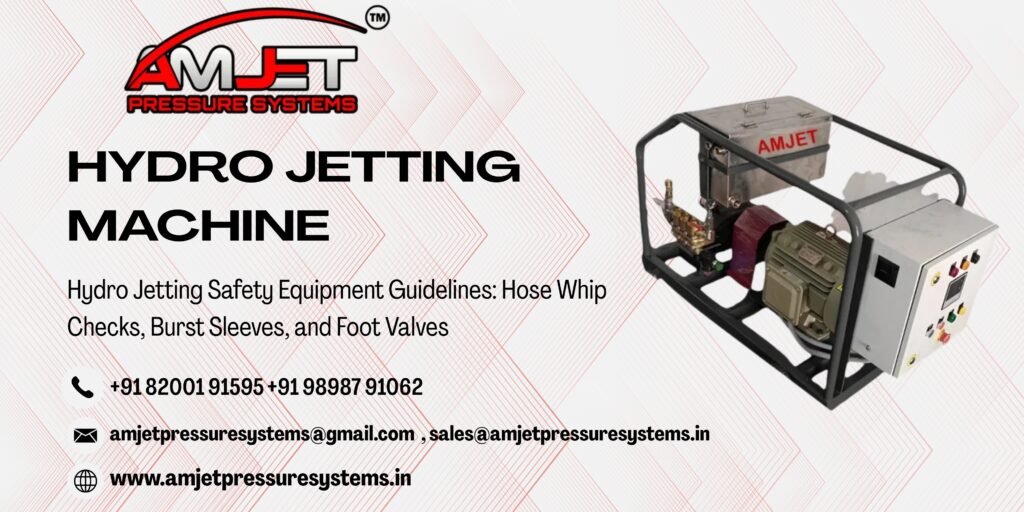
Equipping your site with reliable, continuous-duty water jetting equipment? Explore high-performance hydro jetting machine configurations and heavy-duty industrial water jetting systems built to international safety standards by connecting with Amjet Pressure Systems.