How to Design a Multi-Bay Commercial Car Wash Layout for Maximum Throughput
Operating a successful commercial car wash or automotive service station requires more than just high-performance equipment and heavy-duty pressure washers. The ultimate profitability of your facility relies heavily on spatial engineering and traffic flow optimization. When vehicles enter your property, every bottleneck, poorly angled bay entrance, or inefficient drainage path directly reduces your daily vehicle throughput and revenue potential.
Designing a multi-bay commercial car wash layout requires a careful balance between customer ergonomics, equipment room placement, safety clearances, and water management. Understanding how to map out a high-throughput facility ensures your operations run seamlessly during peak rush hours.
Spatial Planning: Defining the Bay Dimensions and Clearances
The foundation of any multi-bay setup begins with the physical dimensions of the individual wash bays. Cramping space to fit an extra bay usually backfires, leading to customer frustration, vehicle damage, and restricted movement for your staff.
Optimal Bay Dimensions: For standard commercial and SUV-capable wash bays, aim for a minimum width of 4.5 to 5 meters (approx. 15–16 feet) and a length of at least 7 to 8 meters. This leaves ample space on all sides for operators to maneuver high-pressure spray wands, foam cannons, and underbody cleaning equipment without bumping into walls or vehicles.
Vertical Clearance: Ensure a minimum ceiling height of 3.5 to 4 meters. This clearance is non-negotiable if you plan to service commercial vans, light trucks, or vehicles equipped with roof racks.
Traffic Flow and Circulation: Entering and Exiting
A successful layout eliminates crossing traffic paths and prevents vehicle gridlock during high-volume periods.
One-Way Linear Flow: Whenever possible, design your facility with a clear one-way traffic pattern. Vehicles should enter from a dedicated access gate, move smoothly into the wash bays, pull forward into drying or detailing zones, and exit safely onto the main roadway without needing to reverse.
Staging and Queueing Lanes: Allocate dedicated waiting or queueing lanes separate from active traffic corridors. This keeps your main access driveway open and prevents incoming motorists from blocking nearby commercial streets.
Equipment Room Placement and Utility Routing
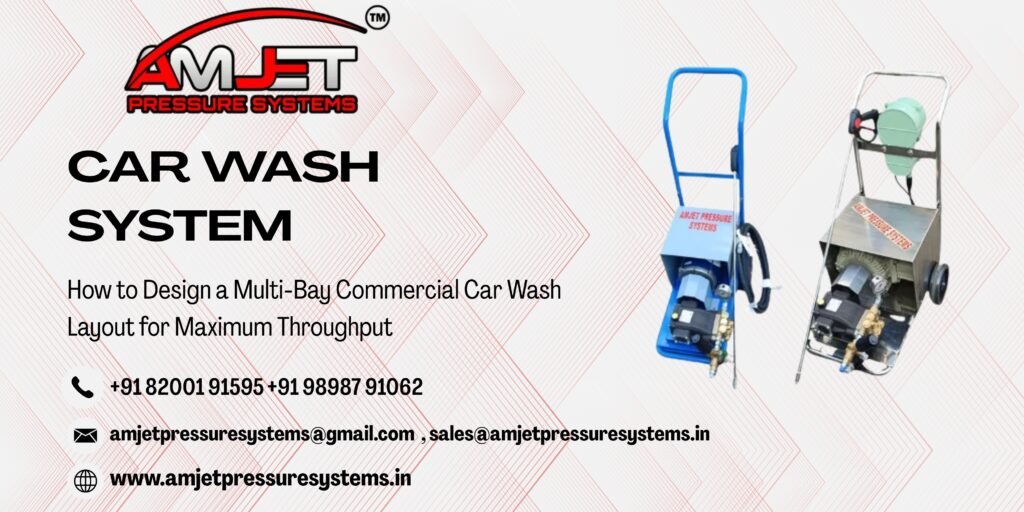
The heart of your cleaning operation—including your commercial-grade Heavy Duty High Pressure Car Washer Systems and pump skids—needs a strategic home.
Centralized Equipment Placement: Position your central mechanical room equidistant from all wash bays. Long high-pressure hose runs create unnecessary pressure drops and increase friction loss.
Protected Utility Trenches: Run water supply lines, electrical conduits, and high-pressure discharge pipes through dedicated, easily accessible underground trenches covered with durable grating. This prevents tripping hazards for staff and protects lines from accidental vehicle weight damage.
Drainage, Slopes, and Environmental Compliance
Managing high volumes of runoff water is one of the most critical engineering challenges in car wash design.
Floor Pitch and Trench Drains: Slope the concrete floor of each wash bay gently toward a central or perimeter trench drain (typically a 1% to 2% grade). Standing water creates slip hazards and breeds sludge accumulation.
Oil-Water Separators: Never route wash bay runoff straight into municipal storm drains without treatment. Integrate a multi-stage silt trap and oil-water separator system to capture sediment, grease, and automotive hydrocarbons before wastewater enters the sewer network.
Conclusion
A well-architected car wash layout transforms a chaotic service station into a streamlined, high-efficiency business operation. By prioritizing spacious bays, smooth traffic flow, and smart utility routing, you set your facility up for long-term operational success.
Explore our range of heavy-duty Heavy Duty High Pressure Car Washer Systems engineered to deliver reliable, high-volume performance across commercial wash bays and vehicle service stations.