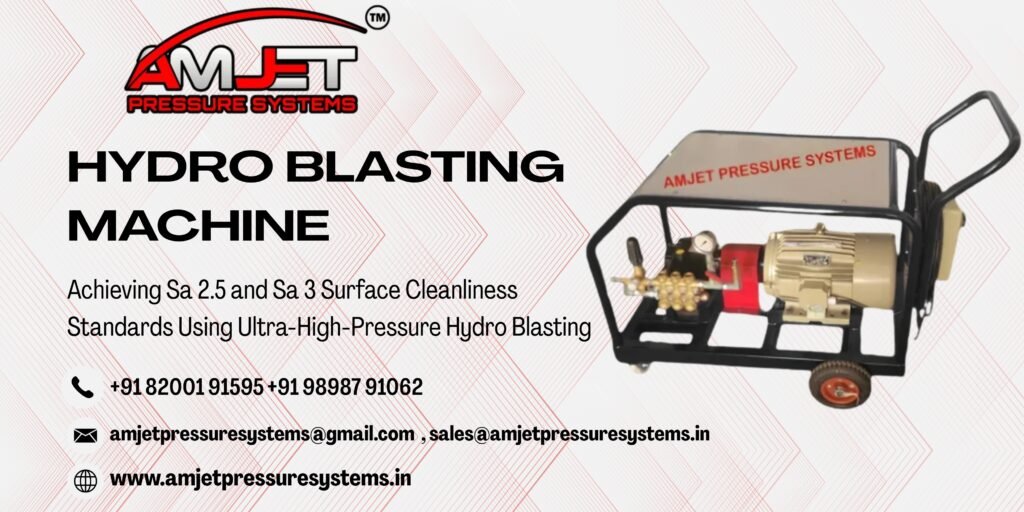
Achieving Sa 2.5 and Sa 3 Surface Cleanliness Standards Using Ultra-High-Pressure Hydro Blasting
In structural steel fabrication, marine shipbuilding, and heavy industrial maintenance, applying a high-performance protective coating is only as successful as the surface preparation that precedes it. If rust, mill scale, salts, or chemical contaminants remain trapped beneath a newly applied epoxy or polyurethane paint layer, premature coating failure, blistering, and sub-surface corrosion are guaranteed.
To regulate coating quality globally, international standards such as ISO 8501-1 define rigorous visual cleanliness levels—most notably Sa 2.5 (Very Thorough Blast Cleaning) and Sa 3 (Blast Cleaning to Visually Clean Steel). While traditional abrasive grit blasting has long been used to achieve these grades, Ultra-High-Pressure (UHP) Hydro Blasting has transformed surface preparation by meeting these strict benchmarks safely, efficiently, and without generating hazardous airborne dust.
Understanding Industrial Surface Cleanliness Standards (Sa 2.5 and Sa 3)
Before applying specialized anti-corrosion systems, steel substrates must meet exact visual criteria:
Sa 2.5 (Very Thorough Blast Cleaning): Under normal visual inspection, the steel must be completely free of visible oil, grease, dirt, mill scale, rust, paint, and foreign matter. Any remaining traces of contamination should show only slight stains as spots or stripes in the form of minor discoloration. This is the baseline standard for most industrial coatings.
Sa 3 (Blast Cleaning to Visually Clean Steel): This is the highest and most stringent visual standard. The steel surface must possess a uniform, metallic luster across 100% of the inspection area, showing absolute zero traces of rust, scale, or foreign residue.
How UHP Hydro Blasting Meets and Exceeds ISO Standards
Achieving Sa 2.5 and Sa 3 using an ultra-high-pressure water stream relies on pure hydrodynamic impact rather than kinetic grit abrasion.
Eradicating Soluble Salts (Chlorides): One major hidden failure point in abrasive grit blasting is that it leaves behind soluble salts trapped in the microscopic pores of the steel. These salts attract moisture through osmosis, causing flash rust under the paint. UHP hydro blasting washes away soluble salts, sulfates, and chlorides down to parts-per-million (PPM) levels, creating a chemically clean substrate that grit blasting cannot match.
Exposing the Original Anchor Pattern: While water jetting does not physically pit or deform the steel to create a mechanical anchor profile (it cleans the existing profile created by initial grit conditioning or original mill fabrication), it strips away every atom of old rust and decaying coatings down to bare metal, perfectly satisfying Sa 2.5 and Sa 3 visual requirements.
Key Operational Advantages Over Abrasive Grit Blasting
Zero Dust Pollution: Grit blasting creates massive clouds of toxic silica dust, making it impossible to operate near sensitive machinery, active production lines, or populated marine environments. Hydro blasting encapsulates debris in a water stream, eliminating airborne particulate hazards.
Spark-Free Operations in Hazardous Zones: In oil refineries, chemical plants, and offshore platforms, abrasive sparks from grit hitting steel present an explosive risk. Water jetting is entirely non-sparking, making it intrinsically safe for explosive atmospheres.
Conclusion
Achieving rigorous international coating standards is critical for long-term corrosion prevention. Ultra-high-pressure hydro blasting provides the ultimate combination of high-speed cleaning, chemical purity, and environmental safety.
Explore our range of heavy-duty Hydro Blasting Machines engineered to deliver exceptional surface preparation results across demanding industrial and marine applications.